
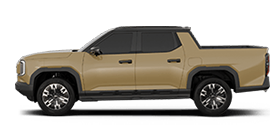
MAXUS Electric Pickups for Camping and Off-Road Adventures: Space, V2L and Caravan Towing Explained
Explore how the MAXUS eTERRON9 supports camping and off-road adventures with a 236 L frunk, V2L output of up to 6.6 kW and a braked towing capacity of 3.5 tonnes.
Table of Contents
1. Quick Answer
2. One Vehicle for the Family and Camping Equipment
3. Camping Storage in the 236 L Frunk and Open Load Bed
4. A Mobile Power Supply: Using V2L at the Campsite
5. Caravan Towing and All-Terrain Driving: What to Check Before Departure
6. Frequently Asked Questions
7. Sources
Quick Answer
The MAXUS eTERRON9 can carry passengers and equipment while supplying campsite power on the same trip. It combines dual-motor all-wheel drive with an All-Terrain System (ATS). The load bed accommodates tents, folding furniture and outdoor equipment, while the 236 L frunk holds items that need to be kept separate. Official overseas-market information also lists V2L and a braked towing capacity of up to 3,500 kg. Caravan trips are an option when the vehicle specification, trailer weight and route conditions are suitable.
• Battery and range: 102.2 kWh battery and a combined WLTP range of 430 km.[1]
• Maximum payload: 650 kg for Luxury and 620 kg for Premium.[1]
• Towing capacity: maximum braked towing capacity of 3,500 kg and maximum unbraked towing capacity of 750 kg.[1]
• Storage: load bed dimensions of 1,658 × 1,600 × 535 mm (Euro specification) and a frunk volume of 236 L.[1][2]
• External power: an external V2L connection providing up to 6.6 kW, plus multiple 2.2 kW sockets in the load bed and frunk.[2]
The figures above and throughout this article apply to the overseas-market eTERRON9 AWD N1 3.5T Double Cab Luxury and Premium versions. Equipment and approvals can differ by country. WLTP range does not represent actual range when towing, fully laden or driving in demanding conditions. Check local model specifications and the owner's manual before buying or travelling.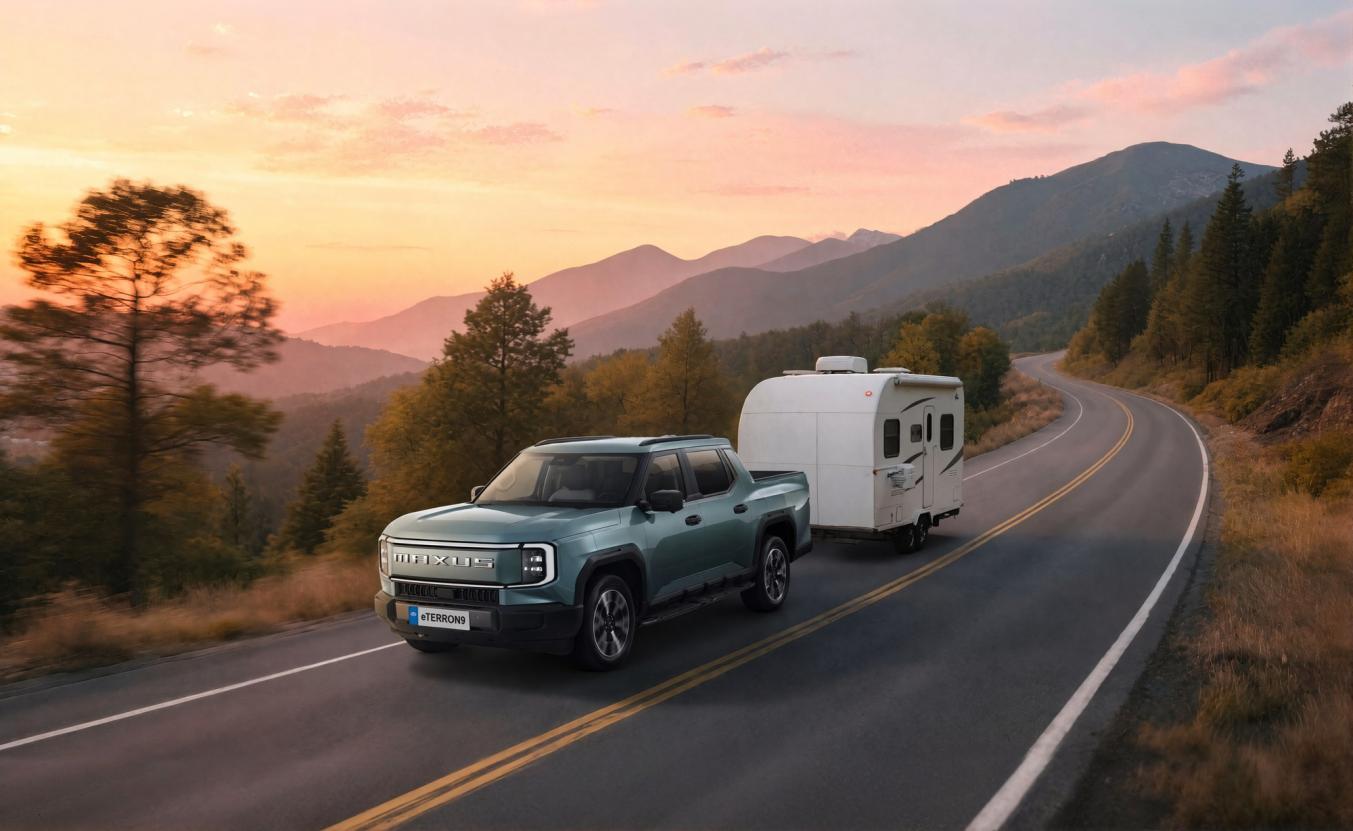
eTERRON9 towing a caravan. Image source: MAXUS.
One Vehicle for the Family and Camping Equipment
A weekend camping trip can involve a long packing list: tents, sleeping bags, a cool box, cooking equipment, folding chairs, children's luggage and perhaps bicycles or fishing tackle. An open pickup load bed accommodates bulkier equipment and keeps wet or muddy items separate from the cabin. The eTERRON9 double cab seats five, allowing family or friends to travel together. Depending on the trip, the load bed can be fitted with approved covers, storage systems or outdoor accessories. These additions increase weight, so confirm load limits with the local dealer or converter before installation.
Dual-motor all-wheel drive and the All-Terrain System (ATS) offer selectable drive modes for different surfaces. Official Belgian information lists six preset modes, including Normal, Mud and Sand, plus a custom mode with adjustments for steering, power delivery, electronic stability control, regenerative braking and air suspension height.[2] Still assess the actual surface on the way to camp: wet grass, soft sand, muddy slopes and standing water present different risks. Check access roads and weather, confirm that the route is open, and consider tyres, ground clearance and the energy needed to return. Off-road drive modes do not make every unpaved surface suitable.
Charging belongs in the camping plan too. Combined WLTP range is measured under prescribed test conditions and provides a reference, rather than a guarantee for a particular route. Low temperatures, sustained high speeds, load, climbing and towing all affect energy consumption. Before heading to a remote campsite, check charging availability and vehicle access along the route, and retain enough energy for the return journey.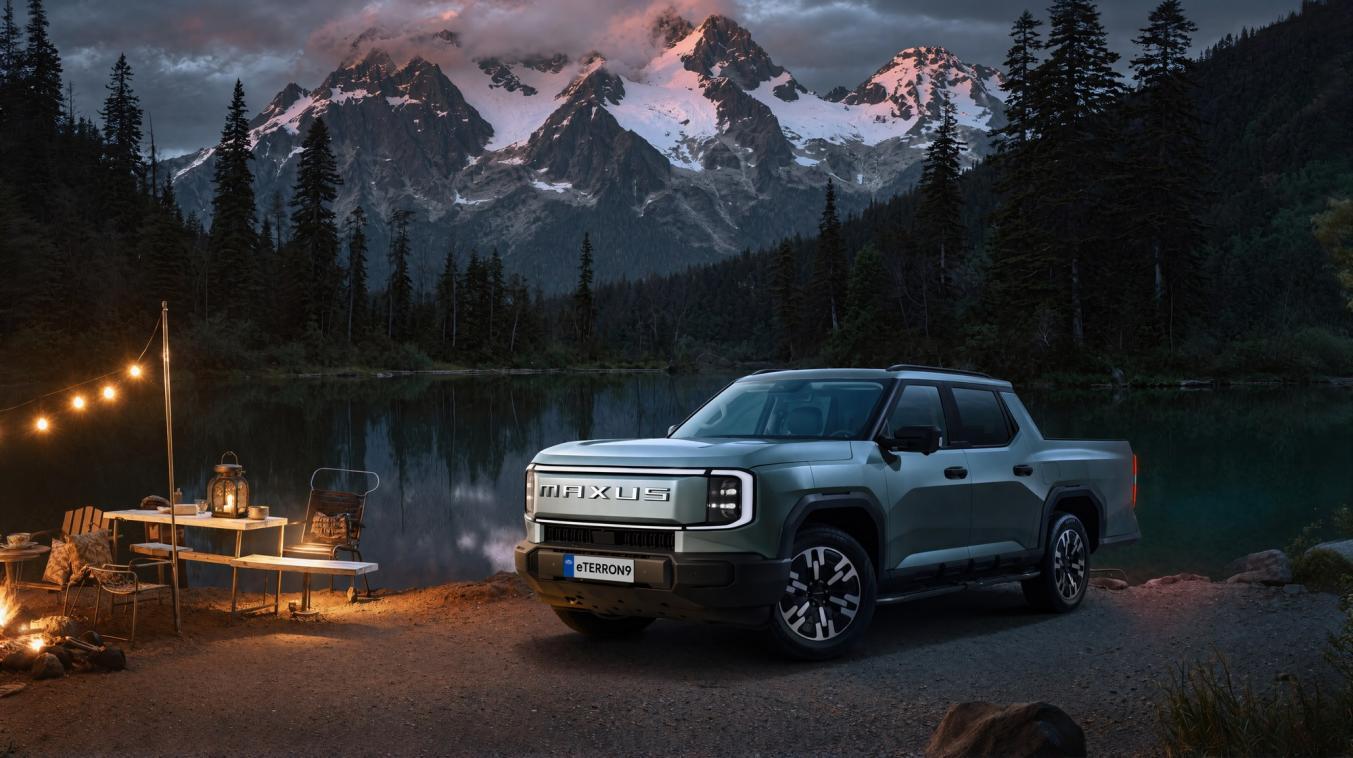
eTERRON9 at a mountain lakeside campsite. Image source: MAXUS.
Camping Storage in the 236 L Frunk and Open Load Bed
The eTERRON9 has a 236 L weather-resistant frunk,[2] suitable for cleaning supplies, footwear, emergency equipment or smaller bags. Check that items fit and can be secured, and follow the owner's manual requirements for frunk storage.
The Luxury and Premium versions have a load bed measuring 1,658 × 1,600 × 535 mm (Euro specification).[1] Position and secure heavier items such as folding furniture and cool boxes low down first, then use soft bags such as tents and sleeping bags in the spaces alongside. Keep drinking water, first-aid supplies, lighting and charging cables accessible. Secure long items to prevent movement under hard braking or on uneven ground.
Account for payload as well as space. Maximum payload is 650 kg for Luxury and 620 kg for Premium.[1] Occupants, roof accessories, load bed covers, drawers, camping equipment and trailer tongue weight all use part of that allowance. After conversions or accessory installation, do not continue estimating available payload from the unmodified vehicle. Check gross vehicle weight and axle loads, and avoid concentrating heavy items at the rear of the load bed.
A Mobile Power Supply: Using V2L at the Campsite
The eTERRON9's Vehicle-to-Load (V2L) function supplies compatible equipment where fixed campsite sockets are unavailable. MAXUS overseas-market information lists multiple 2.2 kW sockets in the load bed and frunk, along with an external V2L connection providing up to 6.6 kW.[2] These can power a compatible portable fridge, campsite lighting or small power tools, or charge camera batteries, subject to each appliance's rating. The frunk and load bed socket supply cannot be used at the same time as V2L through the charging port. Follow the owner's manual for the specific vehicle.
Before use, check appliance rated power and starting demand, and ensure that connections, adapters and the total load comply with the owner's manual. High-power heating appliances may consume substantial energy, so allow for the return trip and unexpected diversions. In rain or damp conditions, plugs, extension leads and appliances must meet outdoor electrical safety requirements. Keep cables clear of wheels, standing water and walkways.
V2L draws energy from the vehicle's battery; it does not provide an additional energy source. For longer trips or campsites without charging facilities, estimate appliance operating time and include that demand in route and charging plans.
Caravan Towing and All-Terrain Driving: What to Check Before Departure
The eTERRON9 has a maximum braked towing capacity of 3,500 kg and a maximum unbraked towing capacity of 750 kg.[1] These are approved limits for the specified versions, not permission to tow any caravan. Check the caravan's actual laden weight, trailer brakes, trailer tongue weight, gross train weight and local driving licence requirements. Drinking water, bicycles, food and luggage all add weight to a caravan.
Towing increases aerodynamic drag and energy consumption, and actual range will generally fall. Do not plan a towing route using the certified range for driving without a trailer. The reduction depends on trailer shape and weight, speed, gradients, weather and driving style, so a fixed percentage is not reliable. When planning charging stops, check whether the site has room for the vehicle and trailer. Some locations may require the trailer to be unhitched before charging.
All-wheel drive and ATS can adapt vehicle settings to the surface, but water crossings, sand and mud still require compliance with access restrictions and the owner's manual. Water depth, gradients, ground bearing capacity and weather can change whether a route is passable. If conditions are uncertain, choose a safer route rather than proceeding.
Frequently Asked Questions
How heavy a caravan can the MAXUS eTERRON9 tow?
The overseas-market eTERRON9 AWD N1 3.5T Double Cab Luxury and Premium versions both have a maximum braked towing capacity of 3,500 kg and a maximum unbraked towing capacity of 750 kg. The permitted trailer weight also depends on gross train weight, trailer tongue weight, trailer brakes and local regulations.
How large is the eTERRON9 frunk?
MAXUS overseas-market model information lists an eTERRON9 frunk volume of 236 L. Whether specific equipment fits depends on item dimensions, securing arrangements and the local vehicle's owner's manual.
What V2L output does the eTERRON9 provide?
There are multiple 2.2 kW sockets in the load bed and frunk, plus an external V2L connection providing up to 6.6 kW. The two supply methods cannot operate simultaneously.[2]
How far can the eTERRON9 travel on a full charge?
The overseas-market eTERRON9 AWD N1 3.5T Double Cab Luxury and Premium versions both have a combined WLTP range of 430 km. This is a certified test figure; load, towing, speed, temperature and terrain affect real-world range.
Do the eTERRON9 Luxury and Premium have the same payload?
No. The overseas-market specification sheet lists a maximum payload of 650 kg for Luxury and 620 kg for Premium. Occupants, equipment, accessories and trailer tongue weight must all be accounted for within the vehicle's payload allowance.
Should camping equipment go in the frunk or load bed?
The frunk suits smaller items that need to be kept separate from the load bed. Tents, folding furniture and bulkier luggage can be arranged and secured according to the load bed dimensions.
Sources
Range, payload, load bed dimensions and towing figures in this article relate to the overseas-market MAXUS eTERRON9 AWD N1 3.5T Double Cab Luxury and Premium versions. Equipment and approvals vary by market. Check local MAXUS specifications and vehicle documents before purchase and use.
[1] MAXUS eTERRON9 overseas-market specification sheet (AWD N1 3.5T Double Cab Luxury / Premium): https://en.saicmaxus.com/uploads/month_202411/files/c63b9093a778f78467098ad3196898c8.pdf
[2] MAXUS eTERRON9 overseas-market V2L information (MAXUS Belgium): https://www.news.maxusmotors.be/maxus-presents-eterron-an-all-electric-pick-up-with-all-wheel-drive
[3] MAXUS eTERRON9 global model page: https://en.saicmaxus.com/car/eTERRON9.shtml

automotive editor
contributor, former automotive editor · contributor on electrified vehicles · editor in chief, specialized in Green Car Reports
View anthor’s articlesTalk to a fleet advisor
Leave your contact details and a specialist will follow up within one business day
Request a consultation